The Man Behind the Machine
Words by: Joshua Matvichuk
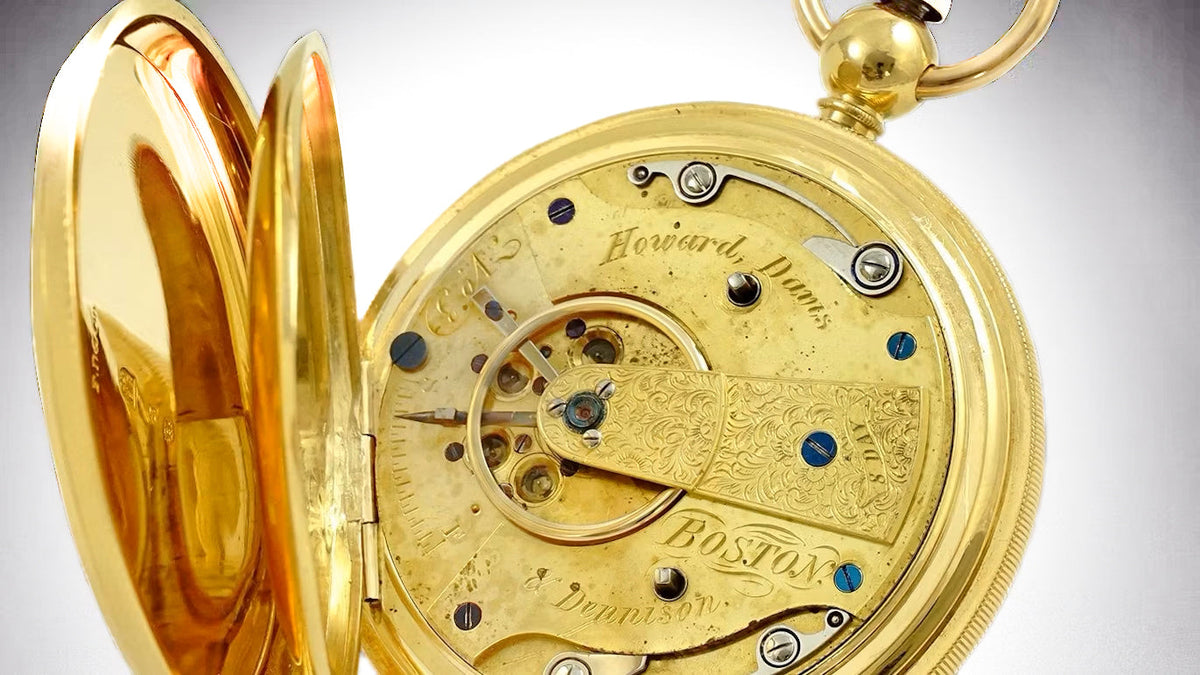
In June of 2019, a seemingly modest gold pocket watch crossed the auction block in New Hampshire with an estimate of $150,000. To the untrained eye, it appeared unassuming. There were no grand complications, no celebrity provenance, and none of the visual drama that often accompanies the world’s most valuable timepieces. Yet, when the hammer finally fell, the watch sold at $300,000, shattering the record for the most valuable American pocket watch and immediately capturing the attention of collectors and historians alike. The reason had very little to do with the watch itself. Instead, it had everything to do with the name engraved upon it: Dennison.
The watch in question was Howard Davis & Dennison No. 3, one of the earliest surviving products of a manufacturing revolution that would fundamentally change watchmaking forever. This watch was the third in a series with the first two going to Dennison’s partners Howard and Davis. Dennison received the third and owned it for the rest of his life. While the auction result made headlines within collecting circles, the sale was ultimately a reminder of something much larger. It served as a rediscovery of Aaron Lufkin Dennison, a man whose influence on modern watchmaking is difficult to overstate, yet whose name remains surprisingly unfamiliar outside the most dedicated horological circles.

Today, Aaron Lufkin Dennison is often referred to as the “Father of American Watchmaking”. It is a title that sounds impressive, but perhaps fails to capture the true scale of his achievement. Dennison did not simply establish a watch company or produce a successful timepiece. He changed the way watches were made. More importantly, he changed the way people thought about manufacturing itself.

To understand why this was so revolutionary, it is worth considering the world into which Dennison was born. In the first half of the nineteenth century, watchmaking was still largely an artisanal craft. The great centres of production were Britain, France and Switzerland, where watches were assembled through networks of highly specialised craftsmen. A wheel might be produced by one workshop, a balance spring by another, and a case by a third before finally being assembled and adjusted by a master watchmaker. The results could be extraordinary, but the process was slow, expensive, and highly dependent on individual skill. Repairs were complex, production was limited, and ownership remained largely confined to those who could afford such luxuries.
Dennison saw things differently.

Born in Maine in 1812, the son of a shoemaker, there was little in his early life to suggest that he would become one of the most influential figures in the history of watchmaking. America itself was still a young nation. European watchmaking was dominant. Switzerland and England produced the finest timepieces in the world, while the United States had almost no meaningful watch industry of its own.
As a young man, Dennison entered the trade as a watch repairer. It was meticulous work, requiring patience and precision. Day after day he sat at his bench handling watches that had been produced by hand, each one slightly different from the next. Every repair was its own puzzle. If a wheel was damaged or a component worn, there was rarely a replacement waiting on a shelf. Parts had to be modified, adjusted, or made entirely from scratch. For most watchmakers this was simply the nature of the craft. For Dennison, it was a problem to be solved.
The more watches he repaired, the more convinced he became that the industry was trapped in an outdated way of thinking. While other industries were beginning to embrace machinery and standardisation, watchmaking remained stubbornly dependent on individual craftsmanship. The process was slow, expensive, and difficult to scale.
Dennison became obsessed with a question that many considered impossible. What if watches could be built on an industrial scale? Were these complex objects any different from the steam engines and industrial looms that had revolutionised the fortunes of a still nascent America? Today the idea sounds almost laughably obvious. In the 1840s it bordered on madness.
The watch was one of the most sophisticated mechanical devices of its age. The tolerances involved were extraordinarily fine. The prevailing wisdom held that true precision could only be achieved by the hands of skilled craftsmen. Machines were simply not capable of producing watch components accurately enough. Dennison disagreed.

Friends and colleagues would later describe a man possessed by his vision. He became convinced that watches could be manufactured using interchangeable parts, allowing them to be assembled more efficiently and repaired more easily. Instead of every watch being a unique creation, components could be produced to such exact standards that one part could replace another without extensive hand fitting. The idea was revolutionary, but it was also ruinously expensive.
In 1850, together with Edward Howard and David Davis, Dennison launched what would become the Waltham Watch Company. The venture consumed enormous amounts of money and encountered seemingly endless setbacks. Machinery had to be invented. Production methods had to be developed from scratch. Investors became nervous. At various points failure appeared inevitable. For many entrepreneurs, those obstacles would have marked the end of the story. For Aaron Dennison, they were merely evidence that the work was not yet finished. Again and again he pushed forward.

The early years were marked as much by frustration as success. Factories struggled. Businesses were reorganised. Ownership structures changed. Yet throughout it all, Dennison remained committed to the same central idea that had first taken hold of him as a young watch repairer sitting at his workbench. Eventually, the breakthrough came.
The watches produced at Waltham demonstrated that precision manufacturing and interchangeable parts were not only possible, but practical. What had begun as a radical theory became a reality. The impact was profound. American watchmaking flourished. Millions of watches would eventually be produced using principles that Dennison had helped pioneer. Those same principles would influence industries far beyond horology, becoming part of the foundation of modern manufacturing itself. But Dennison’s story did not end in America.
In a twist that feels almost poetic, the man who helped create American watchmaking eventually crossed the Atlantic and began a second career in Britain. After leaving Switzerland in 1871 where he helped organise production for the Tremont watch company, Aaron Lufkin Dennison settled in Birmingham, where he helped organise the Anglo-American Watch Company, later renamed the English Watch Manufacturing Company. Never content to rest on past achievements, he continued to pursue new ventures throughout the latter part of his life, eventually partnering with Alfred Wigley to establish Dennison, Wigley & Company, a watch-case manufacturer that reflected the same industrial spirit that had defined his work in America decades earlier. When Dennison died in 1895, his influence endured through the next generation. His sons would go on to rename Dennison, Wigley and company to the Dennison Watch Case Company, choosing to stamp their cases with the initials “ALD” in honour of their father a lasting tribute to the man whose vision had helped reshape watchmaking on both sides of the Atlantic.
By the time Aaron Dennison died in 1895, the world had largely caught up with his ideas. The industry he helped create was thriving. The methods he championed had become accepted practice. The impossible had become ordinary. And like many pioneers, he slowly faded from public memory. Yet every so often history has a way of bringing people back into focus.
In 2019, when the hammer fell on the watch that he carried with him for most of his life collectors were reminded not merely of an early pocket watch, but of the remarkable life behind the name engraved upon it. The watch was important. The man who built the future it represented was even more so.