Article: In Conversation: Nico Lazaro of The Bengal Stripe
In Conversation: Nico Lazaro of The Bengal Stripe
From Americana and Italian industrial design to the quiet confidence of a well-proportioned watch, Nico Lazaro has built The Bengal Stripe around a deeply personal understanding of style. In Los Angeles, we spoke with him about developing taste, the objects we choose to live with, and why the best design rarely needs to shout.
For Nico Lazaro, style is less about knowing the right references than understanding which ones belong to you.
Through The Bengal Stripe, Lazaro explores menswear as an entry point into a much wider conversation around culture, memory, design and identity. His world moves comfortably between Ralph Lauren and Dieter Rams, vintage clothing and Italian industrial design, New England and Los Angeles. The common thread is not a particular aesthetic, but an appreciation for objects with personality, purpose and a sense of permanence.
It is an outlook that naturally extends to watches.
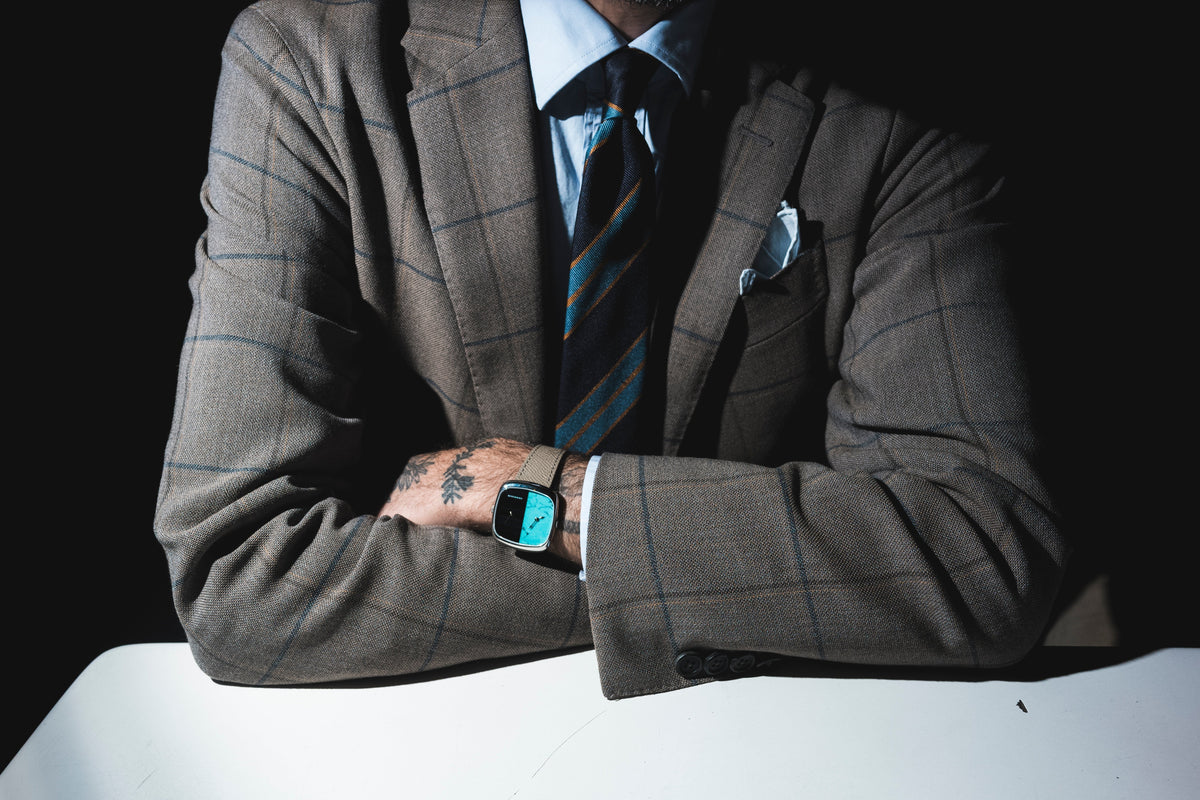
During a recent shoot in Los Angeles, Lazaro wore a Dennison ALD Dual TIme with a split-stone dial, a piece that appealed to him precisely because it felt unusual without trying too hard to be different.
We sat down with Nico to discuss The Bengal Stripe, the evolution of his personal taste, life in Los Angeles, and why restraint remains one of the most compelling qualities in contemporary watch design.

For people who may know the aesthetic but not the full story, how would you describe The Bengal Stripe in your own words?
The Bengal Stripe is really about curiosity. It started as a menswear newsletter, but it’s become a place where I write about style as a reflection of culture, memory, identity, and the things we choose to surround ourselves with. Clothes are usually the entry point, but they’re rarely the whole story.
How has your eye evolved over time? Was there a moment when your taste really sharpened into what it is now?
When I was younger, I was trying to communicate knowledge. I wanted people to know I understood the references. As I’ve gotten older, I’ve become much more interested in communicating myself.
That shift changed everything. Instead of asking, “Is this cool?” I started asking, “Does this actually feel like me?” That’s when my taste really became my own.
What are the recurring references that keep showing up in your world—films, music, interiors, cars, clothes, photography, places?
Americana has always been a throughline for me. Ralph Lauren’s romantic version of America. Old Patagonia catalogues. New England in the fall. Desert landscapes. Hardcore punk. Jazz. Italian industrial design.
They’re all connected by a sense of optimism and lived-in authenticity.
Your work and taste feel very considered but never overworked. How do you know when something looks right?
Usually when I stop noticing it. If I keep tweaking something, it’s often because I’m trying to force it.
The best outfits, photographs or interiors have a sense of ease. They leave room for imperfection. That’s what gives them a sense of personality.

What does Los Angeles give you creatively that other cities don’t?
Permission to mix worlds. You can see someone wearing vintage Levi’s with handmade Japanese shoes, grab tacos from a food truck, drive into the mountains, and end the day at a gallery opening.
LA doesn’t have one dominant style language. It’s constantly remixing influences, and I find that incredibly inspiring.
What’s something you’re drawn to aesthetically that people might not expect from you?
I’m still surprisingly drawn to minimalism. People probably associate me with tailored clothing and vintage references, but I’m equally inspired by Dieter Rams, Donald Judd, and this sense of quiet and deliberate austerity.
I think those influences actually complement one another. Both celebrate objects that are honest about what they are.

When you’re building an image, a look, or even just getting dressed, what’s the balance between polish and personality?
Personality always comes first. Polish should simply make your personality easier to read.
If something is perfectly styled but doesn’t tell me anything about the person wearing it, I’m usually not interested.
Have watches always been part of your visual world, or did they come in later?
Later. I loved clothing long before I understood watches.
But once I realised watches carried the same stories I was already interested in—craftsmanship, design history, engineering and personal ritual—they became a natural extension of that world.
Do you see a watch as jewellery, a design object, a tool, a status signal, or something more personal than all of those?
A little bit of all of those, but mostly it’s a personal object.
It’s one of the few things you interact with constantly throughout the day. You look down at it dozens of times without really thinking. Over time, it becomes associated with memories, routines and moments. That’s much more interesting to me than what it costs.

What drew you to the particular Dennison piece you wore for the shoot?
I’ve always gravitated toward pieces that feel a little outside the mainstream. The proportions, the shape, and especially the split-stone dial felt fresh, but there was still a sense of history behind it.
It reminded me that originality doesn’t always mean inventing something new. Sometimes it’s about revisiting familiar ideas from a different angle.
What do you think Dennison gets right that a lot of modern watch brands miss?
Restraint.
A lot of modern brands feel like they’re trying to prove something with bigger cases, more complications, too many different models, loud marketing. Dennison feels comfortable.
The designs have personality without being theatrical. They feel like objects that are meant to live with you rather than impress someone across the room.
How would you describe the feeling of the watch on the wrist in your own words?
Comforting. It disappears in the best way.
You stop thinking about it as a separate product and start thinking of it as part of your daily uniform. That’s always the goal with great design. It should become an extension of you rather than something you’re constantly mindful of.
Do you think a watch should quietly support a look, or completely change the way someone carries themselves? Where does Dennison sit for you?
The best watches do both. They support the outfit, but they also change how you feel wearing it.
I think confidence often comes from tiny details that nobody else notices. Dennison sits firmly in that camp. It’s understated enough to blend into your wardrobe, but distinctive enough that you carry yourself a little differently because of it.
When you’re styling or choosing a watch, what matters most first: shape, dial, colour, history, or how it makes you feel?
Always how it makes me feel.
The shape and the history are what initially catch my attention, but if I don’t feel like myself wearing it, none of that matters. The pieces I wear the most are rarely the most expensive or technically impressive. They’re the ones that feel most like me.

What kind of person do you imagine wearing Dennison well?
Someone who’s comfortable with subtlety.
They appreciate good design, but they don’t need everyone else to notice it. They’re curious, thoughtful, and probably have a wardrobe that has evolved slowly over many years instead of being built all at once.
Do you think good taste can be taught, or is it mostly about developing confidence in your own point of view?
I think your eye can absolutely be trained. You can learn proportion, history, colour and design.
But taste isn’t just knowing what’s good. It’s knowing what’s good for you. That part only comes through experience and paying attention to your own instincts.
Finally, if you could build your ideal day in LA around a Dennison on the wrist, what does it look like from morning to night?
Coffee on my back porch while the neighbourhood is still quiet, then a walk down Sunset before the city gets busy. Maybe breakfast at Cafe Tropical, a few hours wandering bookstores and vintage shops, then an afternoon at a local watering hole with a few friends and no real agenda.
Maybe one last drive home with the windows down.
That’s my favourite version of Los Angeles: unhurried, optimistic and full of small moments.
It feels a lot like the kind of watch I’d want to wear every day.