Article: Keeping Time in Kuwait
Keeping Time in Kuwait
There are places where watches are bought, and there are places where watches become part of a culture.
Kuwait belongs firmly to the latter.
Its relationship with watchmaking is difficult to understand simply through boutiques, launches or the presence of major maisons. Watches here are social objects. They are discussed, compared, collected and passed between generations. Knowledge travels between collectors, and taste is often remarkably individual. The result is a watch culture that feels both deeply established and unusually curious.
It was into this environment that Time Keeper arrived in 2018.
Founded by three Kuwaiti entrepreneurs Ali Al-Yousifi, Mohammad Al-Yousifi and Ali Al-Ramadhan. Time Keeper began with a shared fascination for the history and craft of watchmaking. What followed has grown into something considerably broader than a traditional retailer.
Today, Time Keeper operates across physical retail, digital media, events and collector culture. Its boutiques include Time Gallery in Kuwait City’s Salhiya Complex and a second location at The Avenues, while its wider community extends through editorial content, Instagram, YouTube, a podcast, WhatsApp and the TK Club. that community now numbers more than 240,000 followers.

The modern watch world is increasingly shaped outside the traditional centres of Switzerland, London, Paris and New York. Collecting communities have developed their own languages and preferences, and nowhere is that more apparent than in the Gulf.
Kuwait in particular has developed a collecting culture in which the established and the unexpected can comfortably coexist. Provenance matters, but so does personality. A significant complication might sit alongside an unusual independent watch; a historic reference alongside something bought simply because its design is compelling.
Time Keeper has become one of the spaces through which that culture expresses itself.
For Dennison, that makes Time Keeper an unusually natural collaborator.
From Birmingham to Kuwait
Dennison’s own story has always crossed borders.
Aaron Lufkin Dennison was an American whose ideas about industrialised watchmaking helped reshape the industry before his attention turned to Britain. The company that carried his name became an important part of British watchmaking, particularly through its expertise in watch cases.
When Dennison returned in 2024, the intention was never simply to reproduce that history. Instead, the archive became a point of departure.
The modern ALD, designed by Emmanuel Gueit, encapsulates that philosophy particularly well. Its 37 × 33.5mm cushion-shaped case draws on the proportions and visual optimism of the 1960s, but its restraint gives it an unusually contemporary character.

Most importantly, it leaves space for material to do the talking.
That has made natural stone central to the modern Dennison vocabulary. Malachite, lapis lazuli, tiger’s eye, aventurine and other stones transform a deliberately simple case into something individual. Pattern, colour and geological accident replace conventional decoration.
It is also where the connection with Kuwait becomes particularly interesting.
Written in Stone
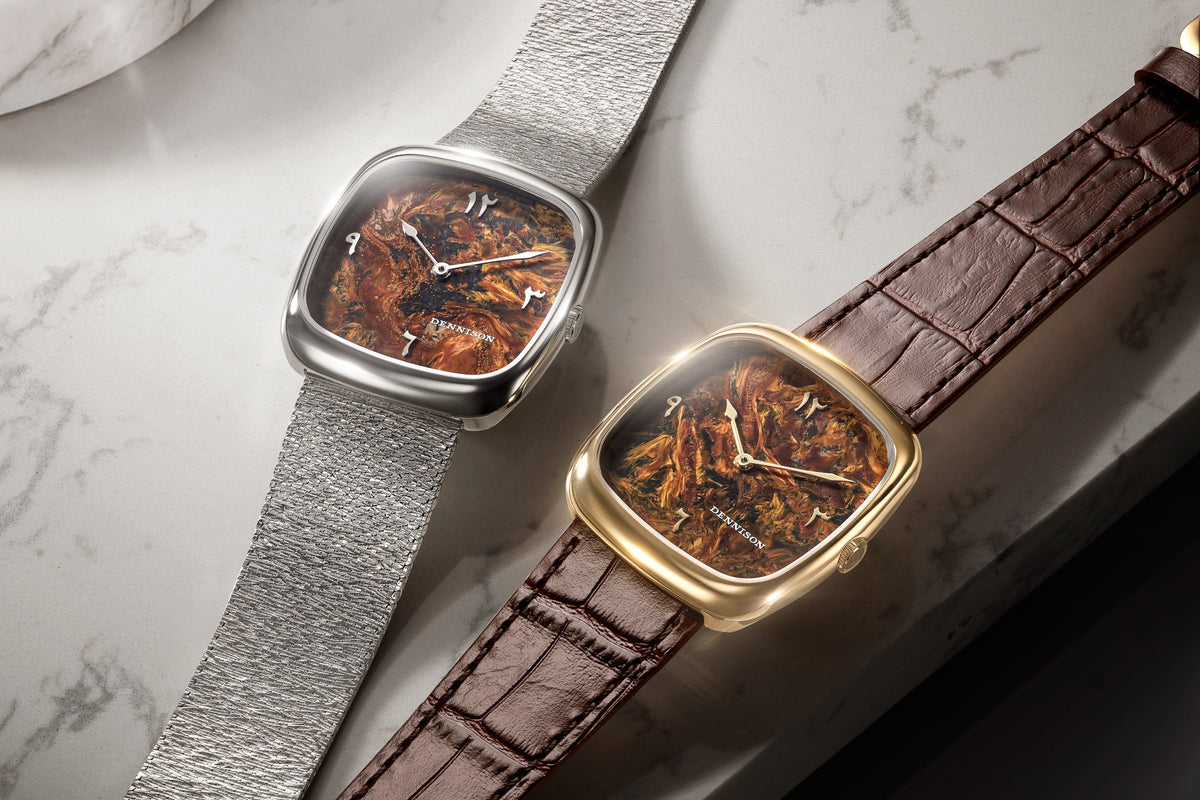
For the Dennison x Time Keeper Edition, the material chosen was Pietersite.
It is an extraordinary stone.
Across its surface, blue, bronze, gold, grey and charcoal appear to move into one another. Some sections can resemble storm clouds; others appear almost metallic. Viewed from different angles, what initially seems dark can suddenly reveal streaks of electric blue or warm bronze.
And because the pattern exists naturally within the material, it cannot be perfectly replicated.
No two dials are the same.
Rather than trying to impose a literal symbol of Kuwait onto the watch, the collaboration therefore takes a more abstract approach to regional identity. The colours and movement within the Pietersite evoke the shifting tones of the Gulf landscape without turning the watch into a souvenir.
There is, however, one deliberate intervention.
For the first time in Dennison’s modern history, applied Eastern Arabic numerals appear at the quarter positions of the dial. They are restrained rather than decorative, integrated into Gueit’s existing architecture rather than placed on top of it.
It is a small detail, but perhaps the most important one.
The watch remains recognisably Dennison. Yet it could only have emerged from this particular collaboration.
A Different Kind of Regional Edition
Regional editions can easily become exercises in symbolism: a familiar watch, a national colour, a recognisable motif and a new name.
This project takes another route.
The starting point was not how to make the ALD look Kuwaiti, but how the design might respond to the tastes of the collecting community surrounding Time Keeper.
That distinction is subtle but important.
Time Keeper’s own evolution suggests why. Its activities now extend from retail into publishing, podcasts, collector gatherings and exhibitions. Its platform also brings together watches from both established manufacturers and younger independent brands. Dennison is already represented among them, with Time Keeper carrying the brand’s natural-stone ALDs and Dual Time models.
The collaboration therefore developed from an existing relationship between retailer, brand and collector rather than appearing as an isolated limited edition.
The result is limited to 50 pieces and available exclusively through Time Keeper. The Pietersite dial sits inside the familiar 37 × 33.5mm ALD case, measuring just 6.05mm thick beneath a sapphire crystal and powered by the Swiss Ronda 1062 quartz calibre. The edition is offered in stainless steel and gold PVD interpretations, with the choice of Dennison’s Bark-Mesh bracelet or embossed brown leather.
But those specifications only tell part of its story.

The Collector as Part of the Design
Perhaps the most compelling thing about using natural stone for a limited edition is that the usual idea of an edition begins to break down.
Fifty watches may leave the same collection, but there are not really fifty identical watches.
One collector might find a dial dominated by midnight blue. Another might discover a seam of bronze running across charcoal. A third could receive something almost entirely different.
The collector therefore participates in the final stage of the design simply through the piece that happens to become theirs. It feels particularly appropriate for Kuwait.
Time Keeper’s growth has been built around the idea that watch culture is ultimately communal: something that exists in conversations, gatherings, private collections and the exchange of knowledge as much as it does behind boutique glass.
Dennison’s collaboration with Time Keeper is a product of that environment.
It connects a British watchmaking name founded by an American pioneer, a contemporary design by Emmanuel Gueit, a stone formed without any regard for uniformity, and a collecting community thousands of kilometres from Birmingham.
Different histories and different cultures, meeting on the wrist.
And in an edition of fifty watches, no two tell quite the same story.