Article: The High Road, Naturally
The High Road, Naturally
Words by: Joshua Matvichuk
Photos by: Cedar Barnes
There are a few things worth knowing before setting off on a road trip through Scotland. The weather will almost certainly change its mind, the roads will be narrower than you’d like, and if you stop to ask a local for directions, there’s a reasonable chance you’ll leave knowing their entire family history.
None of these things should put you off. Quite the opposite, in fact.
Scotland is a country that wears its character rather proudly. The scenery is magnificent, of course, but it’s the people who give the place its particular charm. There’s a warmth to the Scots that often comes disguised as sarcasm, a healthy suspicion of anyone taking themselves too seriously, and an ability to find humour in circumstances that might leave the rest of us feeling rather sorry for ourselves.
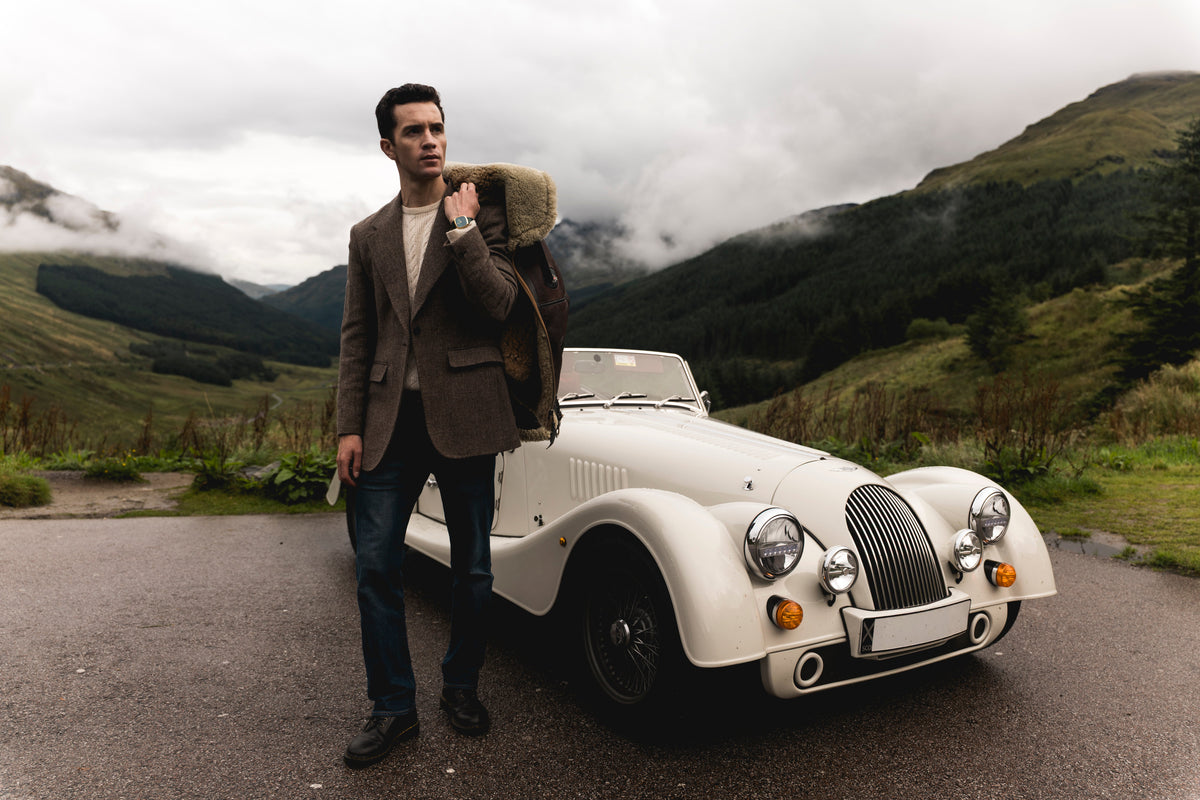
For our latest autumn/winter campaign, we decided to embrace this philosophy and head west, taking a white Morgan sports car through the countryside surrounding Loch Lomond and Inveraray Castle. Two travellers, a beautiful old-fashioned motor car, and a loose understanding of where we were supposed to be going.

A fairly decent start, all things considered.
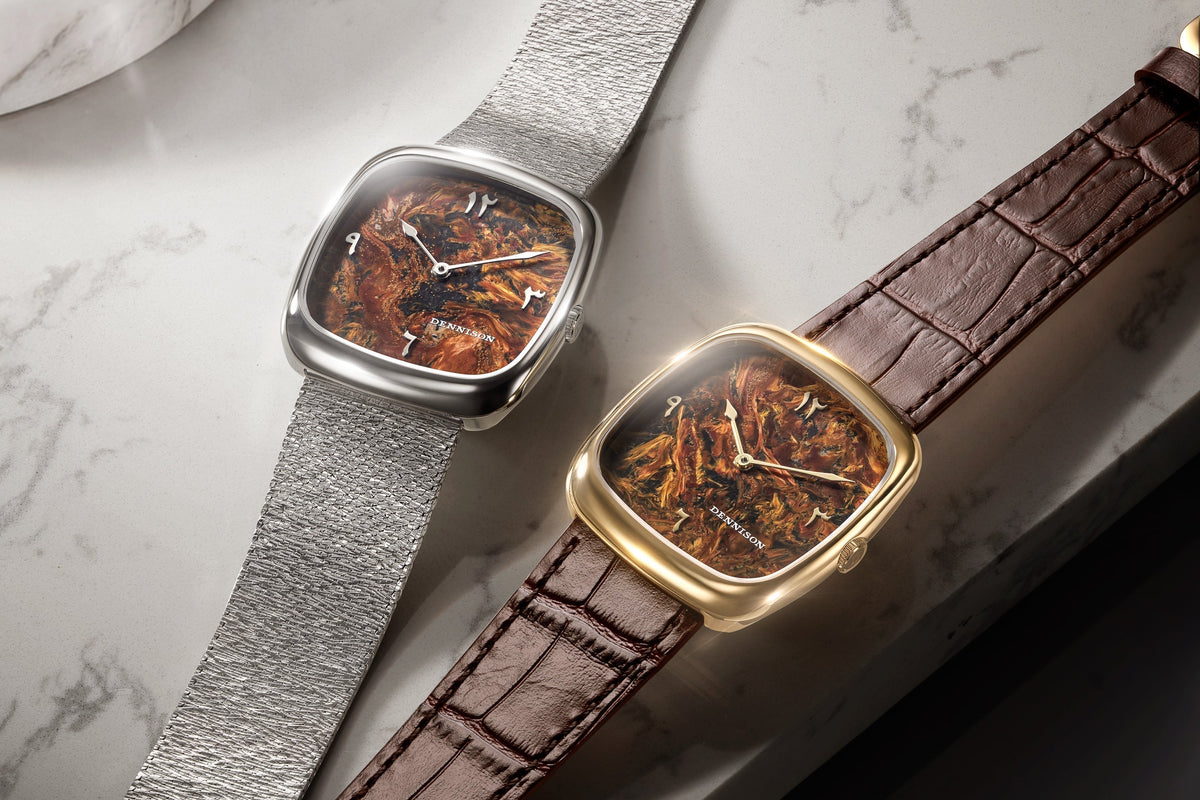
Accompanying us, naturally, were a selection of Dennison watches. There was something rather appealing about taking these small, carefully considered objects into a landscape that has never been particularly concerned with the passing of time. It seemed an appropriate setting for a collection that takes much of its inspiration from the past, without being entirely beholden to it.
Leaving the bustle of Glasgow behind, the roads towards Loch Lomond offer one of the more pleasant introductions to the Scottish countryside. The city gradually gives way to woodland and rolling hills, before the landscape opens onto the great expanse of water that has inspired poets, musicians and travellers for centuries.
Loch Lomond is the largest freshwater loch in Great Britain by surface area, stretching some 36 kilometres through the landscape. Its southern reaches are relatively gentle, with wooded shores and scattered islands, while further north the mountains rise dramatically from the water.
The loch is perhaps best known through the traditional Scottish song The Bonnie Banks o’ Loch Lomond, whose famous refrain promises to take the high road or the low road. The song itself is rather more melancholy than its cheerful reputation might suggest, but that’s Scotland for you. Even the sad songs tend to sound rather good after a few drinks.

Driving along the loch in a Morgan feels like a wonderfully appropriate way to experience the place. The British manufacturer has been building cars in Malvern since 1909, and has spent much of that time resisting the temptation to make them look like anything else.
The long bonnet, sweeping wings and traditional proportions belong to a different era of motoring, when driving was as much about the experience as getting somewhere. There’s a pleasing honesty to it all. You feel the road, hear the engine, and become rather more conscious of the world passing by.

The Scots, one suspects, would approve. There’s something to be said for a machine that knows exactly what it is and doesn’t feel the need to make a fuss about it.
Of course, travelling through Scotland in autumn comes with certain practical considerations. The temperature has a habit of dropping without warning, the wind can be rather enthusiastic, and the rain arrives whenever it pleases. Locals are generally unimpressed by any complaints on the subject.
“It’s just a wee shower,” someone might tell you, as the sky turns a particularly threatening shade of grey.

The trick is to accept it. A little rain gives the hills their colour, the lochs their atmosphere, and the whole countryside that wonderful, slightly brooding quality which makes Scotland so photogenic. Besides, there’s always somewhere to stop for a cup of tea.

Continuing west towards Argyll, the roads wind through a landscape of forested hills, open farmland and small settlements. It’s a part of the country that rewards a slower pace, not least because the scenery has a habit of appearing around corners when you least expect it. Our destination was Inveraray, a handsome little town on the shores of Loch Fyne, best known for its castle and its long association with Clan Campbell.
Ask a local about a particular castle or stretch of countryside and you may well receive a history lesson, although whether every detail survives close examination is another matter entirely. The Scots are gifted storytellers, and a good story is not always improved by excessive concern for the facts.
There’s a certain philosophy to life here that becomes increasingly apparent the longer you stay. People tend to value good company, a proper conversation, and the ability to laugh at themselves. Wealth and status may impress some, but putting on airs is a fairly reliable way to invite a sharp remark.

In Glasgow, someone who becomes a little too pleased with themselves might be told to “gie yersel’ peace” — roughly speaking, to give it a rest. It’s a useful expression, and one that could probably be applied rather liberally elsewhere in the world.

Perhaps this is what makes Scotland such an enjoyable place to travel. The grandeur of the landscape is constantly balanced by the grounded nature of the people. There is beauty everywhere, but very little encouragement to become too sentimental about it.
For Dennison, the journey felt like a natural fit. A watch, much like a Morgan, is an object that can be appreciated for its design, its craftsmanship and the history behind it, but it is ultimately something to be worn and enjoyed. There is no great need to make a performance of the whole thing.

By late afternoon, the light had begun to retreat behind the hills, leaving the landscape in those peculiar shades of green and grey that Scotland seems to have invented for itself. The Morgan sat by the roadside, its white bodywork carrying the evidence of a day’s driving, while the last of the mist gathered around the mountains.

It occurred to us that there was something rather fitting about the whole arrangement. A British sports car that had little interest in modern conventions, a collection of watches whose design owed something to another era, and a country that has spent centuries doing things very much its own way. None of them seemed particularly inclined to change for anyone.
We had set out to photograph watches, but Scotland had rather inconveniently insisted on becoming the main character. The lochs, the hills, the weather, and the people had all played their part, leaving us with considerably more stories than we had anticipated and rather fewer dry clothes.
As we climbed back into the Morgan for the final stretch, there was no particular hurry to reach our destination. The road ahead was empty, the engine was warm, and somewhere beneath a jacket cuff, a Dennison quietly kept track of the afternoon.
For once, nobody seemed especially interested in knowing the time.
And that, we thought, was rather the point.